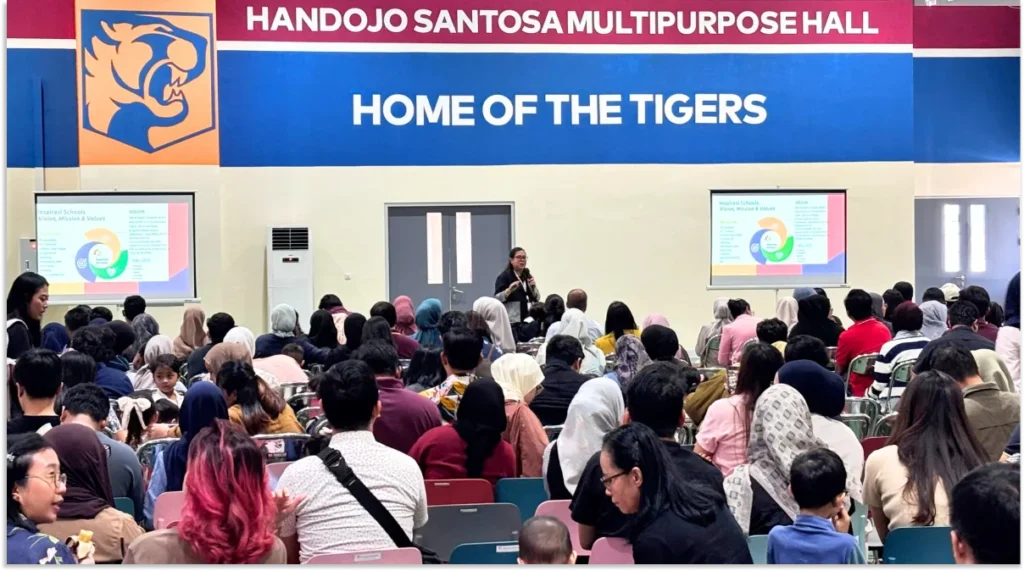
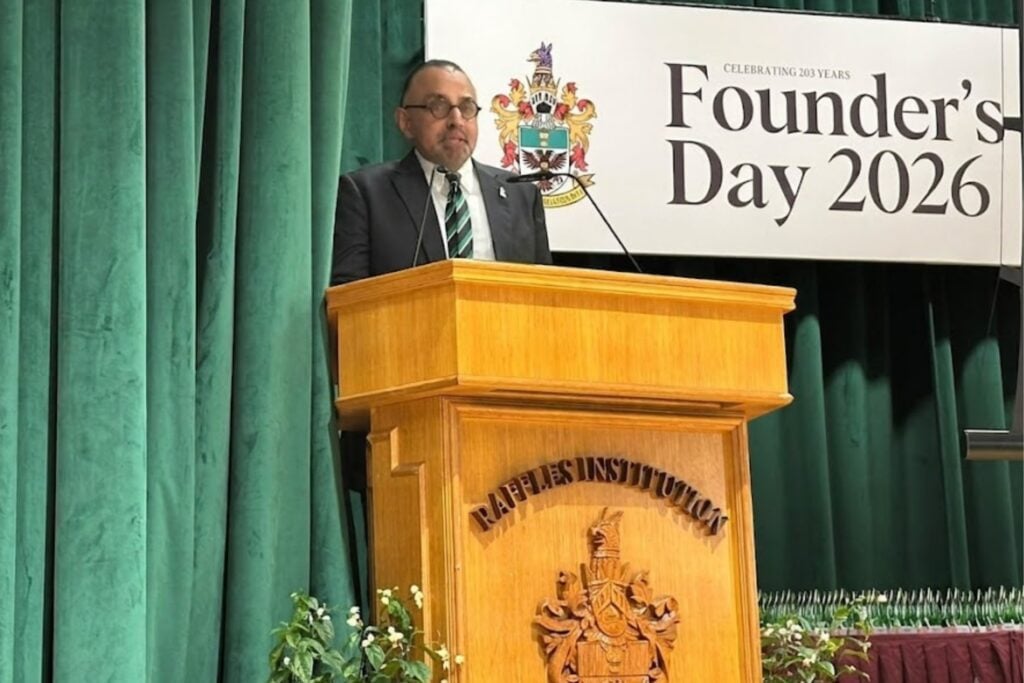
Within the space of three months, I found myself commemorating the Founder’s Day of two institutions separated by 173 years of history.
The first was Raffles Institution, my alma mater, where I had the rare privilege of returning as Guest of Honour for its 203rd Founder’s Day celebrations in Singapore. The second was SIS, the school group I founded, where, as Chairman of the Board of Governors, I stood before our community to mark its 30th Founder’s Day in Jakarta.
The juxtaposition of these two occasions prompted a question that extends far beyond education.
Founded in 1823, Raffles Institution has occupied a singular place in Singapore’s educational and national development. Among its alumni is Singapore’s founding Prime Minister, Lee Kuan Yew, together with generations of cabinet ministers, judges, diplomats, entrepreneurs, scientists and public servants who have shaped the nation’s institutions and public life. SIS, by contrast, was established in 1996 with a very different purpose: to make high-quality international education accessible to families across Indonesia and beyond, who might otherwise never have had such opportunities.
Separated by nearly two centuries, the two institutions differ profoundly in age, context and mission. Yet standing before both communities, I found myself reflecting on the same question:
Why do some institutions endure across generations, continually renewing themselves without losing their essential character, while others—despite talented people, impressive campuses, abundant resources and ambitious strategies—gradually lose their identity?
I have come to believe that the answer lies not in buildings, budgets or rankings, but in something far less visible.
It lies in what I describe as Moral Architecture.
Walking through the grounds of Raffles Institution, one senses this almost immediately. At the heart of the campus, the central atrium displays the portraits and names of former Principals and generations of student leaders, quietly honouring those who have shaped the Institution across two centuries. Nearby, the statue of Sir Stamford Raffles stands in quiet permanence, reminding every generation that they are part of a story far greater than themselves.
Standing there, I found myself reflecting on those who had come before us. What convictions guided their leadership? What difficult decisions did they confront? Their personalities, philosophies and circumstances undoubtedly differed. Yet the fact that Raffles Institution now celebrates its 203rd Founder’s Day suggests that each generation understood one enduring truth: they were never owners of the Institution. They were merely its custodians.
That feeling deepens when one steps into the Raffles Museum.
A faded school scarf. A weathered hockey stick. Handwritten letters. Old report cards. Photographs from another era. Even a school jacket much like the one I once proudly wore.
Viewed individually, they are ordinary artefacts. Together, they tell an extraordinary story.
They remind us that great institutions are not built solely by visionary founders or celebrated leaders. They are built by countless students, teachers, Principals, Governors and staff who quietly preserve traditions, strengthen culture and pass forward values they themselves inherited.
The past never truly leaves an institution like Raffles Institution. It lives in its buildings, its museum, its school song and, above all, in its people. Every generation leaves something behind for the next.
It is this invisible inheritance that I describe as Moral Architecture.
Unlike physical architecture, Moral Architecture cannot be designed by architects, purchased through generous funding or installed by consultants. Governments cannot legislate it, nor can strategic plans manufacture it.
It is built patiently over decades through thousands of decisions: how leaders exercise authority, how teachers nurture their students, how success is defined, how failure is confronted, what achievements are recognised and, perhaps most importantly, what principles an institution refuses to compromise.
Every decision leaves its mark.
Every conversation reinforces expectations.
Every crisis reveals character.
Slowly, almost imperceptibly, these moments accumulate. Decisions become habits. Habits become culture. Culture shapes identity. Identity, preserved across generations, becomes legacy.
When SIS was established in 1996, the Board of Governors of Raffles Institution placed its confidence in what was then an untested educational vision. It supported the establishment of the first SIS school by making available two distinguished educators from within the Institution’s network. Their contribution extended far beyond curriculum design, academic systems or administrative practice. They transmitted something far more enduring: an understanding of what a school should stand for, how it should treat its people and what responsibilities it should assume beyond the classroom.
I had always recognised and appreciated their expertise.
However, returning to Raffles Institution transformed my understanding. Standing once again before the Rafflesian community, I felt the depth of the institutional inheritance that had been passed on to SIS.
Raffles Institution had not merely helped establish a school. It had helped shape an institution.
Without consciously intending to do so, it had transmitted part of its own institutional DNA. It had shown us that schools exist not merely to deliver academic excellence, but to cultivate character, preserve values and prepare each generation to become faithful custodians of something greater than themselves.
Looking back over the past thirty years, I now see that many of the principles that have guided SIS—our emphasis on integrity, compassion, service, long-term stewardship and educational purpose—did not emerge by accident. They were nurtured from the very beginning through an institutional philosophy inherited from those who believed that education is ultimately a public trust.
Today, SIS has grown into an internationally recognised group of schools serving thousands of students across Indonesia and beyond. Campuses have expanded. Programmes have evolved. Leaders have come and gone. Yet the values planted in those earliest years continue to shape the Institution’s character.
For me, this has been the greatest lesson that an enduring institution like Raffles Institution has imparted. Great institutions are not distinguished simply by the prominence of their alumni, the scale of their campuses or the wealth of their endowments. Their defining characteristic is their ability to preserve their identity while continually renewing themselves. They understand that methods may evolve, leaders will inevitably change and circumstances will differ, but the principles upon which the institution is built must remain steadfast.
Each generation inherits an institution shaped by those who came before. Its responsibility is not merely to manage it, but to strengthen it and leave it worthy of those who will come after.
Each generation inherits something precious.
Each generation strengthens it through its own stewardship.
Each generation passes it on with greater integrity than when it first received it.
In an age preoccupied with innovation, rankings and short-term results, this lesson has never been more relevant. Buildings weather. Curricula evolve. Strategies are rewritten. Leaders eventually retire.
But institutions endure when every generation understands that it is not merely managing an organisation, but safeguarding a legacy.
That, ultimately, is the essence of Moral Architecture.
It is the invisible foundation upon which every enduring institution rests.
Abstract
This article explores why some institutions endure across generations while others gradually lose their identity. Drawing on reflections from the anniversaries of Raffles Institution and SIS, Jaspal Sidhu introduces the concept of Moral Architecture, the invisible foundation built upon values, culture, leadership, and consistently upheld decisions that are preserved from one generation to the next. Enduring institutions are distinguished not only by their achievements but also by their ability to preserve their identity while continuously adapting to change. Each generation serves as a steward, entrusted with the responsibility of receiving, strengthening, and passing on these enduring values to future generations, ensuring that the institution’s legacy remains alive, relevant, and resilient over time.